



Related posts

Reading Terrarium Humidity: Where to Put the Hygrometer

Humidity readings vary hugely across a single enclosure. Where to place probes, how misting changes the number, and what shedding tells you.
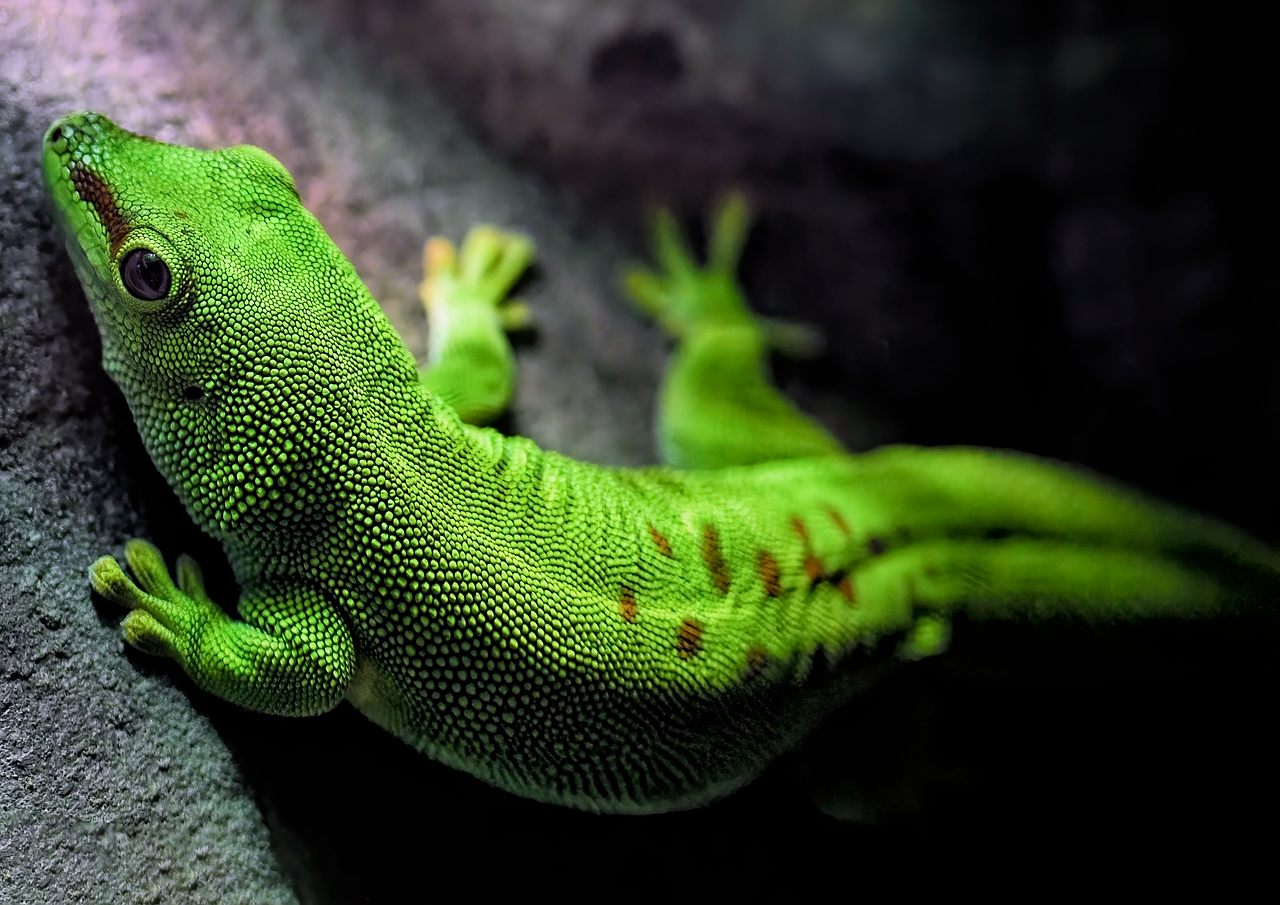
Feeding by hand teaches an animal that a hand entering the enclosure means food. That association is the reason behind a large share of defensive bites, and it is easily avoided.
Offering prey on tongs separates “hand appears” from “food appears”. The animal strikes at the tongs, not at you, and over time it stops treating an approaching hand as a feeding cue. That matters most with species that feed by ambush and strike quickly.
There is a second benefit. Prey held slightly off the substrate is not dragged through loose bedding, which removes one of the main routes to accidental substrate ingestion.
Give distance. Suitable for larger species, for anything with a fast strike, and for anyone who would rather not have a hand near the animal at all. Look for rounded or coated tips — sharp metal points can injure an animal that strikes past the prey.
Better control for small prey and small animals — a gecko taking insects, or a juvenile that would be overwhelmed by large tongs. Less reach, more precision. See feeding and handling tools.
Many keepers end up with one of each rather than choosing.
Some keepers move animals to a bare feeding tub. It eliminates substrate ingestion entirely and keeps the main enclosure cleaner. The trade is handling stress, both moving the animal and moving it back after it has eaten — which for some species risks regurgitation. Species and temperament decide which way this goes; it is not a universal recommendation.
Tools go from prey to enclosure to prey again. Wash with hot water and unscented soap after each session, dry fully, and store somewhere clean. Stainless steel is chosen for this reason — it takes repeated washing without pitting.
If you keep more than one animal, use separate tools per enclosure, or wash thoroughly between them. Cross-contamination between enclosures is a real route for spreading parasites and infection.
Support the body rather than gripping. Avoid handling for 48 hours after a feed for species prone to regurgitation, and during a shed when the animal is already stressed and its vision is impaired.
Wash hands before and after every interaction. Reptiles commonly carry salmonella without being unwell themselves, which is a household hygiene matter rather than a sign of a sick animal.
How you feed changes what tools you need. Frozen-thawed prey is warmed and offered on tongs, and it stays on the tongs until the animal takes it. Live prey is a different exercise entirely, needs supervision, and should never be left in an enclosure unattended — rodents in particular will injure a snake that is not interested.
Whichever you use, offer with a tool. The habit is what protects you, not the specific method.
A refusal is common around a shed, during a seasonal slowdown, or after a move, and is usually not a cause for concern on its own. What matters is the pattern: repeated refusals combined with weight loss is a vet conversation, not a feeding technique problem.
Resist the urge to keep offering repeatedly in one session. Put the prey away and try again in a few days.
Keep frozen prey in a sealed container in a freezer separate from food if you can, and thaw in a sealed bag in cool water rather than warm — thawing too fast spoils the prey and can make an animal ill. Never microwave.
Wash tongs, tweezers and any thawing container immediately after use. Reptiles commonly carry salmonella without showing any signs, so the hygiene here is for the household rather than for the animal.
Animals learn patterns quickly. Feeding at a consistent time, in a consistent way, with the same tool, produces a calmer feeding response than an irregular schedule where the appearance of a hand is unpredictable. That calmness is worth as much as the physical distance the tongs give you.
Open the enclosure the same way each time. Sudden movements from above read as a predator approaching to most species, and an animal that starts a feed in a defensive state is more likely to strike at the wrong thing.
Note what was offered, whether it was taken, and roughly what it weighed. Over a few months this is the clearest picture you will get of whether an animal is thriving, and it turns a vague sense that something is off into a fact you can bring to a vet.
A note in a phone is enough. The value is in the pattern, not the format.
Check tong tips for burrs and tweezers for splayed points. A tip that has bent out of alignment grips unevenly and is more likely to drop prey mid-offer, which is exactly the moment a hand ends up in the enclosure to retrieve it.
See the tools we stock, or ask us what suits the species you keep.
Open daily 08:00–19:00